Showing posts with label Oil War. Show all posts
Showing posts with label Oil War. Show all posts
Saturday, September 3, 2011
West Point Study - Libyan 'Rebels' Are Also Most Likely To Be The 'Foreign Fighters' Killing US Troops In Iraq

[Click for full size chart. Courtesy of West Point Military Academy and Land Destroyer]
Taken from a US West Point study [West Point, PDF] these graphs created by data obtained in Iraq clearly show that Libya's eastern region, and the cities of Darnah and Benghazi in particular, provided by far more militants found fighting US troops in Iraq than any other nation, including Saudi Arabia.
Further, a major part of the Libyan "rebel" army is still on U.S. State Department Terrorist Organization sanctions list:
"Belhaj/al-Hasidi and his men are being portrayed as reformed terrorists despite the fact that they are still LIFG fighters and LIFG itself is still listed as an international terrorist organization."
All docs at the above link, and an update here:
"West Point CTC Confirms LIFG Terrorists Leading Libyan Rebellion - then apologizes for them."
Friday, September 2, 2011
More Reasons The West Wants Muammar al-Gadffi Dead Or Gone (via William Blum, The Anti-Empire Report)

Part 1, "Why They Want Muammar al-Gadaffi Dead... The War On Libya Is A War On Most Of Africa" is here
The following is excerpted from: Libya and the world we live in, William Blum, The Anti-Empire Report September 1st, 2011
The desire to get rid of Gaddafi had been building for years; the Libyan leader had never been a reliable pawn; then the Arab Spring provided the excellent opportunity and cover.
As to Why? Take your pick of the following:
Gaddafi's plans to conduct Libya's trading in Africa in raw materials and oil in a new currency — the gold African dinar, a change that could have delivered a serious blow to the US's dominant position in the world economy. (In 2000, Saddam Hussein announced Iraqi oil would be traded in euros, not dollars; sanctions and an invasion followed.) For further discussion see here.
A host-country site for Africom, the US Africa Command, one of six regional commands the Pentagon has divided the world into. Many African countries approached to be the host have declined, at times in relatively strong terms. Africom at present is headquartered in Stuttgart, Germany. According to a State Department official: "We've got a big image problem down there. ... Public opinion is really against getting into bed with the US. They just don't trust the US." (The Guardian (London), June 25, 2007)
An American military base to replace the one closed down by Gaddafi after he took power in 1969. There's only one such base in Africa, in Djibouti. Watch for one in Libya sometime after the dust has settled. It'll perhaps be situated close to the American oil wells. Or perhaps the people of Libya will be given a choice — an American base or a NATO base. Another example of NATO desperate to find a raison d'être for its existence since the end of the Cold War and the Warsaw Pact.
Gaddafi's role in creating the African Union (ed. Libya is one of five countries along with Algeria, Egypt, Nigeria and South Africa, that cover 75 percent of the AU's budget). The corporate bosses never like it when their wage slaves set up a union. The Libyan leader has also supported a United States of Africa for he knows that an Africa of 54 independent states will continue to be picked off one by one and abused and exploited by the members of the Triumvirate. Gaddafi has moreover demanded greater power for smaller countries in the United Nations.
(Editorial note from Auntie Imp: More information about Libya's relations with the African Union and the country's funding of development projects throughout Africa can be found here. The funding of those projects was contingent on the recipient nation's attempts at reducing government corruption.)
The claim by Gaddafi's son, Saif el Islam, that Libya had helped to fund Nicolas Sarkozy's election campaign could have humiliated the French president and explain his obsessiveness and haste in wanting to be seen as playing the major role in implementing the "no fly zone" and other measures against Gaddafi. A contributing factor may have been the fact that France has been weakened in its former colonies and neo-colonies in Africa and the Middle East, due in part to Gaddafi's influence.
Gaddafi has been an outstanding supporter of the Palestinian cause and critic of Israeli policies; and on occasion has taken other African and Arab countries, as well as the West, to task for their not matching his policies or rhetoric; one more reason for his lack of popularity amongst world leaders of all stripes.
In January, 2009, Gaddafi made known that he was considering nationalizing the foreign oil companies in Libya. He also has another bargaining chip: the prospect of utilizing Russian, Chinese and Indian oil companies. During the current period of hostilities, he invited these countries to make up for lost production. But such scenarios will now not take place. The Triumvirate will instead seek to privatize the National Oil Corporation, transferring Libya's oil wealth into foreign hands.
The American Empire is troubled by any threat to its hegemony. In the present historical period the empire is concerned mainly with Russia and China. China has extensive energy investments and construction investments in Libya and elsewhere in Africa. The average American neither knows nor cares about this. The average American imperialist cares greatly, if for no other reason than in this time of rising demands for cuts to the military budget it's vital that powerful "enemies" be named and maintained.
For yet more reasons, see the article "Why Regime Change in Libya?" by Ismael Hossein-zadeh, and the US diplomatic cables released by Wikileaks — Wikileaks reference 07TRIPOLI967 11-15-07 (includes a complaint about Libyan "resource nationalism")
William Blum is the author of:
Killing Hope: US Military and CIA Interventions Since World War 2
Rogue State: A Guide to the World's Only Superpower
West-Bloc Dissident: A Cold War Memoir
Freeing the World to Death: Essays on the American Empire
Portions of the books can be read, and signed copies purchased, at www.killinghope.org
Thursday, July 28, 2011
Why They Want Muammar al-Gadaffi Dead... The War On Libya Is A War On Most Of Africa
Updated... MORE reasons why the West wants Muammar al-Gadffi dead
Also let it be noted that Reuters has modified their 'Factbox'. There are a number of strategic-to-the-West countries such as Somalia where their mention as having been assisted by Libya has been redacted. Yours truly has seen the original un-expurgated copy, and it is reproduced in full here. I stand by this copy, complete with all errors, ie. "...the Libyan Central Bank announced Libya would provide $50 in grants..."
At the top... For the Keep It Simple Silly crowd.
Muammar al-Gaddafi put $97 billion of his country's money 'where his mouth is' to keep Africa from needing Western Imperial assistance on the condition that the African states receiving the aid rid themselves of corruption and nepotism.
Consider that Western "Assistance" looks something like this...
Contractors And Others Steal Half Of Food Aid To Somalia
"New York - At least half of the World Food Programme's food supplies to Somalia's needy people has been diverted by unscrupulous contractors, radical Islamist militants and even UN staff in the country, the New York Times reported Wednesday.
The Times said an unpublished report by the UN Security Council would recommend that UN Secretary General Ban Ki-moon launch an investigation into WFP's operations in Somalia considering the severity of the food aid diversion."
[In case you need a catch-up on 'corruption' there's a whole other piece Auntie posted, including a discussion of "Why DOES Somalia NEED "food aid" in the first place?" Here.]
Continuing...
So it's sort of obvious that, in a very real way, the War on Libya is being fought because Libya was attempting to bring down an African network of corruption, and attempting to foil the continued maintenance by the West of an ongoing status quo... You can call it 'economic war', being pursued against most all the nations of Africa.
Here's how Libya's aid to Africa is being/has been being spent:
Source: Reuters, Factbox: Libyan aid and investment projects in Africa
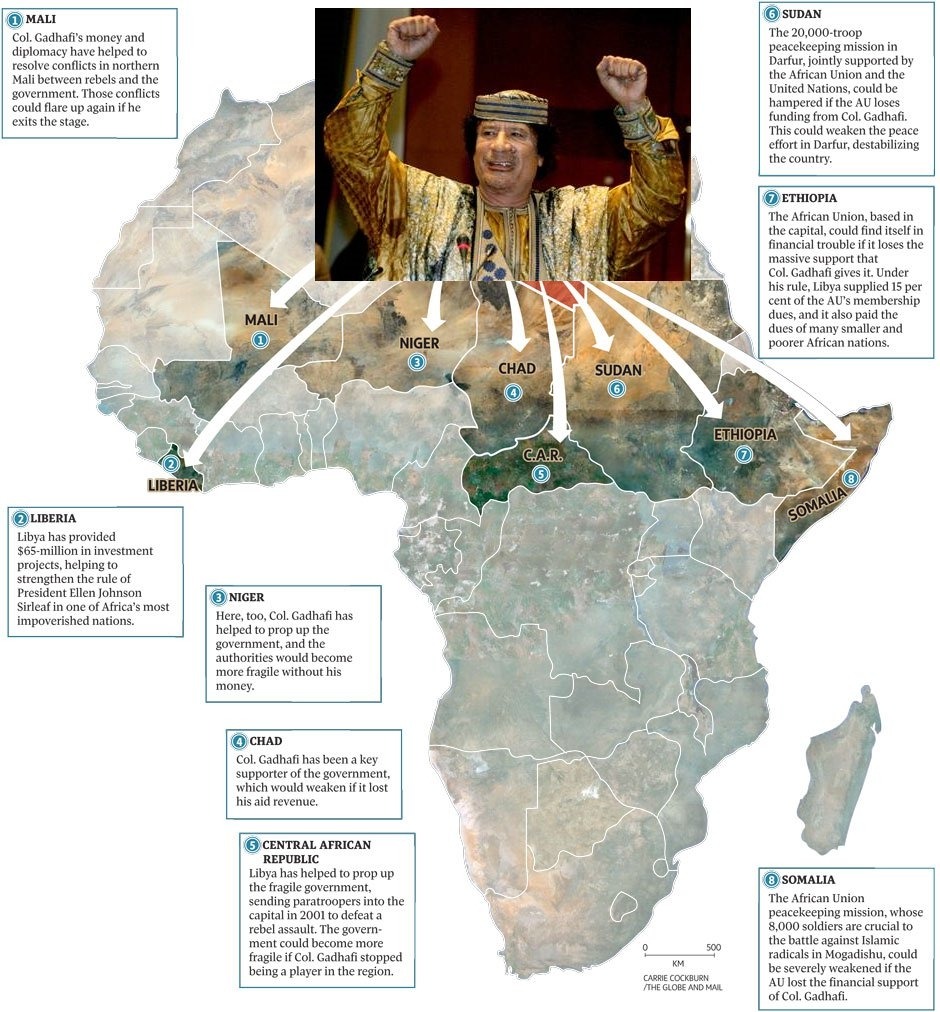
AFRICAN UNION: Libya is one of the biggest contributors to the budget of the African Union. A Libyan diplomat told Reuters Libya is one of five countries -- the others are Algeria, Egypt, Nigeria and South Africa -- which cover 75 percent of the Union's budget. "Libya makes its full required contribution to AU funds. Not all countries do and that buys it influence," a senior African Union official said.
MALI: For several years Mali has been confronted with the activities of the radical Islamist militia Al-Qaeda in the Islamic Maghreb in its northern deserts. Gaddafi’s money and diplomacy have helped to resolve conflicts in northern Mali between rebels and the government. In 2010 Libya has given Mali two security planes to combat insecurity in the north of the country. These conflicts could flare up again if Gaddafi exits the stage. Nowadays Gaddafi has many supporters in Mali who regularly march to protest against the Western-led military intervention in Libya.
CONGO: Libya has put $65 billion into sovereign wealth funds, including one which is specifically designed to make investments in Africa. The Libyan Arab African Investment Company, a vehicle of Libya's Africa sovereign wealth fund, owns Le Meridien, one of the biggest hotels in Congo. The hotel is undergoing refurbishment paid for by Libyan investment. In 2010, Libya planned to fund the building of a highway north of Congo's capital Brazzaville, where also the building of a mosque is planned.
LIBERIA: Libya has provided millions in investment projects, helping to strengthen the rule of President Ellen Johnson Sirleaf in one of Africa’s most impoverished nations. Gaddafi's help includes the funding of a rubber processing factory built in Gbarnga, Bong County, a technical and vocational school for the handicapped, as well as Libyan assistance in helping Liberia tackle the food crisis and renovation for the Ducor Intercontinental Hotel.
NIGER: Also in Niger Gaddafi has helped to prop up the government and the authorities would become more fragile without his financial help. Libyan Prime Minister Al-Baghdadi Ali al-Mahmoudi visited Niger in August 2010 and announced the creation of a $100 million investment fund for Niger as part of a strengthening of bilateral ties. Under earlier agreements, Libya is contributing 100 million euros for the construction of a Trans-Sahara highway in the north of Niger, according to sources close to Niger's foreign ministry. The local subsidiary of Libya Oil, along with Total, are the major players in Niger's fuel retailing business.
CHAD: Gaddafi has been a key supporter of the government, which would weaken if it lost his aid revenue. Chad has been plagued by civil wars and invasions after its independence from France in 1960. After years of unrest, Gaddafi seals a peace agreement for Chad between four Chadian rebel groups and the Chadian government in 2007, which agreement was signed in Sirte.
In 2010 Libya made a huge investment in Chad's National Telecom, which meant a boost of the number of the Chadian mobile phone users from 100,000 to two million.
CENTRAL AFRICAN REPUBLIC: Libya has helped to prop up the fragile government, sending paratroopers into the capital in 2001 to defeat a rebel assault. In 2008 Gaddafi played a role in the formation of a peace agreement between the government and rebel groups.
MAURITANIA: Gaddafi was the first head of state to visit after a 2008 coup which brought President Mohamed Ould Abdel Aziz to power. Aziz, who subsequently won a presidential election, has visited Gaddafi several times since then. Even Mauritanian opposition politicians have gone to Tripoli to pledge allegiance to the Libyan leader. Mauritania has debts to Libya of about $200 million. During discussions on debt relief in May 2010, the Libyan Central Bank announced Libya would provide $50 (Misprint by Reuters) in grants to build a hospital and a university. The university is to be named after Gaddafi.
SUDAN: The 20,000-troop peacekeeping mission in Dafur, jointly supported by the African Union and the United Nations, could be hampered if the African Union (AU) loses funding from Gaddafi and destabilize the country. Gaddafi, who blamed the crisis in Darfur on Israel, made a number of attempts to broker peace talks between Darfur rebels and the Sudanese government.
In October 2010, Gaddafi warned ahead of a vote on possible independence for South Sudan that a partition of the country would be a “contagious disease” that could spread to other African states.
ETHIOPIA: The African Union, based in Ethiopia's capital, could find itself in financial trouble if it loses the massive support that Gaddafi gives it. Under his rule, Libya supplied 15% of the AU’s membership dues, and it also paid the dues of many smaller and poorer African nations. To seek for a solution of the Eritrea-Ethiopia conflict, Gaddafi has sent a special envoy to Ethiopia in 2000. In 2008, Libya's OiLibya bought Shell Ethiopia. This agreement also included retaining all Shell employees, who were hoping to work in a better environment since a long time
SOMALIA: The African Union peace keeping mission, whose 8,000 soldiers are crucial to the battle against Islamic radicals in Somalia's capital Mogadishu, could be severely weakened if the AU lost the financial support of Gaddafi. In 2008 Libya decided to grant an investment fund to Somalia through the Sahel-Saharan Investment and Trade Bank to fund infrastructures such as roads and bridges within Somalia.
GAMBIA: Libyan firms own two hotels and the "Dream Park" entertainment centre in Gambia. Gambian agriculture has received support from Libya, including a donation of seven new tractors. In 2009 Gaddafi gave two camels to Gambian President Yahya Jammeh as a gift. The Libyan and Gambian presidents have exchanged visits and senior Gambian officials attended ceremonies in September to mark the anniversary of Gaddafi coming to power. On September 7, 2009, Gambia celebrated the 40th anniversary of the Al Fateh Revolution: "In Libya everyone enjoys Freedom!".
Friday, October 15, 2010
No More Happy Motoring - There Is No "Plan B", North America "remains highly vulnerable to a liquid fuel emergency disruption"
To meet climbing global requirements, OPEC will have to increase its output from 30 MBD to at least 50 MBD. Significantly, no OPEC nation, except perhaps Saudi Arabia, is investing sufficient sums in new technologies and recovery methods to achieve such growth. Some, like Venezuela and Russia, are actually exhausting their fields to cash in on the bonanza created by rapidly rising oil prices. (p. 26)
A severe energy crunch is inevitable without a massive expansion of production and refining capacity. While it is difficult to predict precisely what economic, political, and strategic effects such a shortfall might produce, it surely would reduce the prospects for growth in both the developing and developed worlds. (p. 28)
Well, the amounts needed from OPEC are quite, shall we say, 'ambitious,' as they amount to an additional two Saudia Arabias coming on line in order to make up the shortfall. A massive crunch is not otherwise avoidable.Future Chaos: There Is No "Plan B"
Let's be honest; there are no more Saudia Arabias to be found...
by Chris Martenson
Fri, 15 Oct 2010
Note: This article builds on my recent report, Prediction: Things Will Unravel Faster Than You Think. It explores the coming energy crunch in more detail by looking at existing government planning and awareness, and the implications of what international recognition of Peak Oil as early as 2012 might mean.
 The hard news is that there is no "Plan B." The future is likely to be more chaotic than you probably think. This was the primary conclusion that I came to after attending the most recent Association for the Study of Peak Oil & Gas (ASPO) in Washington, DC in October, 2010.
The impact of Peak Oil on markets, lifestyles, and even national solvency deserves our very highest attention - but, it turns out, some important players seem to be paying no attention at all.
ASPO conferences tend to start early, end late, and be packed with more data and information than should be consumed in one sitting.
Despite all this, I was riveted to my seat. This year's usual constellation of excellent region-by-region analyses confirmed what past participants already knew: Peak Conventional Oil arrived a few years ago, and new fields, enhanced recovery techniques, and unconventional oil plays are barely going to keep up with demand over the next few years.
But there were two reports that really stood out for me.
The first was given by Rear Admiral Lawrence Rice, who presented the findings of the 2010 Joint Operating Environment (a forward-looking document examining the trends, contexts, and implications for future joint force commanders in the US military), which spends 76 pages summarizing the key trends and threats of the world.
"Energy" occupies six of those pages, and Peak Oil dominates the discussion.
Among the conclusions (on page 29), we find this hidden gem, which uses numbers and timing that are eerily similar to those that I put forth in my April 2009 report, Oil - The Coming Supply Crunch:
By 2012, surplus oil production capacity could entirely disappear, and as early as 2015, the shortfall in output could reach nearly 10 MBD. (Source)In Full, At EnergyBulletin.com
Tuesday, April 13, 2010
Untenable Lifestyle Alert! US military warns oil output may dip causing massive shortages by 2015 - Guardian UK
"The actual report can be found here (PDF) but the peak oil assertions are buried fairly deep inside (see p.29), and certainly not underlined in the summary... so we have a fairly schizophrenic approach here, with peak oil acknowledged but downplayed... (for the 2005 view on peak oil by the US Army, see also this report (PDF))
It looks like someone found the nuggets deep in the report, and fed them to friends in the media. Interesting times..."

(Say Buh-Bye To All That "Stuff")
The Wicks Review on UK energy policy published last summer effectively dismissed fears but Lord Hunt, the British energy minister, met concerned industrialists two weeks ago in a sign that it is rapidly changing its mind on the seriousness of the issue.Further...
...there are signs that the US Department of Energy might also be changing its stance on peak oil. In a recent interview with French newspaper, Le Monde, Glen Sweetnam, main oil adviser to the Obama administration, admitted that "a chance exists that we may experience a decline" of world liquid fuels production between 2011 and 2015 if the investment was not forthcoming.
("...the answer to the issue of knowing when, where and in which quantities additional sources of oil should be put on-stream remains widely “unidentified” in the eyes of the most prominent official analyst on energy inside the Obama administration.")
 In Other Words:
Say goodbye to a culture based on 'plastic crap' folks. The last few drops of 'black blood' will be used to power the Pentagon's military machine defending us from a world of enemies we've created for ourselves, NOT to run your car on your last long drive down to the store for a sixxer and some cigs. Did you ever think otherwise?
Even the food we eat is grown in an artificial environment based on petroleum derived fertilizers, and the pills you take to stay calm... petroleum-based production facilities and ingredients... poised to be unavailable as American society collapses.
Terry Macalister
guardian.co.uk
Sunday 11 April 2010 18.47 BST
• Shortfall could reach 10m barrels a day, report says
• Cost of crude oil is predicted to top $100 a barrel
The US military has warned that surplus oil production capacity could disappear within two years and there could be serious shortages by 2015 with a significant economic and political impact.
The energy crisis outlined in a Joint Operating Environment report from the US Joint Forces Command, comes as the price of petrol in Britain reaches record levels and the cost of crude is predicted to soon top $100 a barrel.
"By 2012, surplus oil production capacity could entirely disappear, and as early as 2015, the shortfall in output could reach nearly 10 million barrels per day," says the report, which has a foreword by a senior commander, General James N Mattis.
It adds: "While it is difficult to predict precisely what economic, political, and strategic effects such a shortfall might produce, it surely would reduce the prospects for growth in both the developing and developed worlds. Such an economic slowdown would exacerbate other unresolved tensions, push fragile and failing states further down the path toward collapse, and perhaps have serious economic impact on both China and India.

Sunday, February 28, 2010
Lied To Again? General Odierno Requests More Combat Forces In Iraq (beyond the Obama deadline)
Odierno requests more combat forces in Iraq -- beyond the Obama deadlineIn full at The Best Defense, Foreign Policy Magazine
by Thomas E. Ricks
February 25 2010
In a move that could force President Obama to break his vow to get all combat troops out of Iraq by August of this year, his top commander in Iraq recently officially requested keeping a combat brigade in the northern part of the country beyond that deadline, three people close to the situation said Wednesday.
Gen. Raymond Odierno asked for a brigade to try to keep the peace in the disputed city of Kirkuk, but only got a polite nod from the president when the issue was raised during his recent meetings in Washington, according to two of the people familiar with the discussions. If the brigade in northern Iraq is indeed kept in Iraq past the deadline, there will be a fan dance under which it no longer will be called a combat unit, but like the six other combat brigades being kept past the deadline, will be called an advisory unit.
I can imagine the press releases that will follow-
"Three U.S. Army soldiers were killed last night in an advisory operation . . . ."
Labels:
Disinformation,
Endless War,
Imperial War,
Iraq,
Lies,
Oil War,
Pentagon,
US Military,
War On Iraq


Tuesday, February 23, 2010
You're Gonna Have To Kill Someone For Your 'NIMBY' "Green"[tm] Lifestyle
The budget for the Pentagon's SouthCom command has increased dramatically over the last few years... and we're "Muscling Latin America"
Here's ONE reason why:
Most of the lithium is mined in Chile, Argentina and China and sold by only a handful of companies. Bolivia, led by the Anti-American President Evo Morales, recently discovered that one of its decommissioned salt mines harbored giant reserves of lithium....
.
.
.
...The United States used to produce its own lithium and REEs, but most of the domestic mines have closed because mines in Latin America and China are able to operate much cheaper." (and Lithium is one of the most toxic elements on the face of the planet along with Cadmium, another rare material used in high tech batteries. You wouldn't want either mining operation in YOUR back yard. Even if you COULD live near these operations)
 The world's next resource conflict (UPI)
BERLIN, Feb. 22 (UPI) -- The next resource conflict could be about minerals and rare earth elements needed to fuel the green economy, as China, which supplies most of the minerals, is considering limiting exports.
There is great hope for a green boom to transform the CO2-heavy world economy into one that is less dependent on fossil fuels and more sustainable. Experts envision solar panels and wind turbines to produce clean power and heat and electric cars to cruise tomorrow's roads.
The problem with these technologies is that they rely on minerals and rare earth elements, or REEs, which are produced by politically unpredictable countries...
...When it comes to REEs (Rare Earth Elements, needed for hybrid cars, wind turbines, solar panels and defense industry products), China is the new kid on the block. In charge of more than half the global reservoirs, China supplies around 95 percent of the world's REEs.
This worries experts: A single mine in Mongolia accounts for 80 percent of China's production, so an earthquake or a flood in that region could severely disrupt global supplies.
And don't forget a political earthquake. Recently, Beijing indicated it plans to reduce exports of its minerals in a bid to save supplies for domestic use.
China has a quickly growing green technology industry and its solar panels and wind turbines are already competing with products from Europe and the United States, so they increasingly need the REEs themselves.
The situation is similarly dire for lithium, which forms the basis of the batteries intended to power the electric car boom. According to the Hyundai Research Institute, 80 percent of the world's lithium reserves are buried under just three countries...
In Full

Subscribe to:
Posts (Atom)

Visitors To Auntie Imperial's News & Blog Review
Thanks For Stopping By

 Posts
Posts


 Auntie Imperial Says:


